
Building Bridges Network April 2026 Community, Connection & Care
A Space Where Connection Happens
There is something quietly powerful about a room full of people who genuinely care. Not just professionally, not just in the way a job description demands, but in the way that keeps you up at night, that makes you show up early and stay late, that drives you to keep looking for better answers on behalf of the people you support. That is the kind of room you walk into at Building Bridges.
On April 30, 2026, the Woodcroft Community Neighbourhood Centre became that room. From 1:30 PM, practitioners, providers, coordinators, and community members gathered not simply to network or sit through a presentation, but to share, to listen, and to grow together. The event lived up to everything the Building Bridges initiative was created to be: a platform for honest conversation, practical insight, and the kind of human connection that makes the community services sector stronger.
This blog captures what happened that day — the knowledge shared, the organisations that showed up, the resources offered, and the spirit of collaboration that made it a morning worth remembering.
What Is Building Bridges?
Building Bridges is more than a networking event. It is a deliberate, collaborative initiative built to connect, educate, and empower everyone working in and around the disability and community services sector. Founded on the belief that progress happens fastest when people work together, it creates a welcoming space where providers, professionals, leaders, and community members can come together to share knowledge, discuss challenges, and discover practical solutions in real time.
Each event is designed around two core goals:
Stronger Connections — bringing people and organisations together to form partnerships that last beyond the event itself.
Practical Growth — focusing on real-world challenges and opportunities that help organisations thrive while improving outcomes for participants.
The format blends expert insights, open discussion, and genuine networking opportunities. Sessions have covered everything from NDIS reforms and workforce development to innovation, leadership, and growth strategies. Every attendee is expected to leave with both new knowledge and new connections — not one or the other.
At its heart, Building Bridges is about tearing down silos. The community services sector is full of hardworking, passionate people who often operate in isolation from one another. Building Bridges exists to change that — for organisations, for professionals, and ultimately for the participants and community members that everyone serves.
Giving Back as a Core Value
One of the most tangible expressions of Building Bridges' values is its commitment to giving back at every event. Attendees are invited to bring food donations, which are collected and distributed to local community organisations supporting individuals and families in need. This simple act of generosity sets the tone for the entire gathering: this is a community that does not just talk about care — it practises it.

What Was On April 2026 Edition?
The April 30 event carried a particularly meaningful theme: community stories, lived experience, and lessons learned across the broader community services sector. The spotlight was placed not on statistics or policy documents, but on people — their journeys, their insights, the hard-won wisdom that comes from working at the coal face of care delivery.
Guest speakers took to the floor to share experiences that illuminate better practice, build stronger relationships, and foster more connected supports. The conversations that followed were wide-ranging and rich, touching on topics that matter deeply to anyone working in or around the disability, ageing, and community services space.
What made this edition especially impactful was the range of organisations present — not just disability service providers, but peak bodies, government agencies, health organisations, and technology innovators. Each brought a different lens, and together they created a picture of the sector that was both honest about its challenges and optimistic about its direction.
Stories, Insights & Honest Conversations
Walking into the Woodcroft Community Neighbourhood Centre, the atmosphere immediately felt different from a standard conference. The room was arranged to encourage conversation, not just passive listening. People arrived early. Introductions were warm. There was a palpable sense that everyone present had something meaningful to contribute — and that they were genuinely interested in what others had to say.
The guest speakers set the tone with stories grounded in reality. These were not polished corporate presentations. They were accounts of challenges navigated, lessons absorbed the hard way, and innovations discovered through necessity. Practitioners shared what actually works when you are supporting someone through a crisis. Coordinators spoke about what clients genuinely need versus what the system is designed to deliver. Leaders reflected on the cultural shifts needed within organisations to truly centre the participant.
What emerged was a collective conversation about how the sector is evolving — and what each person in the room could do to contribute to that evolution. The lived experience shared by speakers created a rare honesty in the room. When someone speaks from personal experience, it cuts through the jargon and reaches people in a way that a policy document never can.
Beyond the formal program, the conversations happening between sessions and over refreshments were arguably just as valuable. Business cards changed hands. Phone numbers were exchanged. Collaborations were floated. Problems that had felt intractable in isolation suddenly had potential solutions when the right two people found themselves in the same room.
This is what Building Bridges does best — it creates the conditions for connection. The rest, as the saying goes, writes itself.
A Wealth of Support for the Sector
One of the standout features of the April 2026 event was the breadth and depth of resources available. Organisations from across multiple sectors attended, each offering information, guidance, and practical support that attendees could take back to their own work.
EmployAbility championing disability employment for
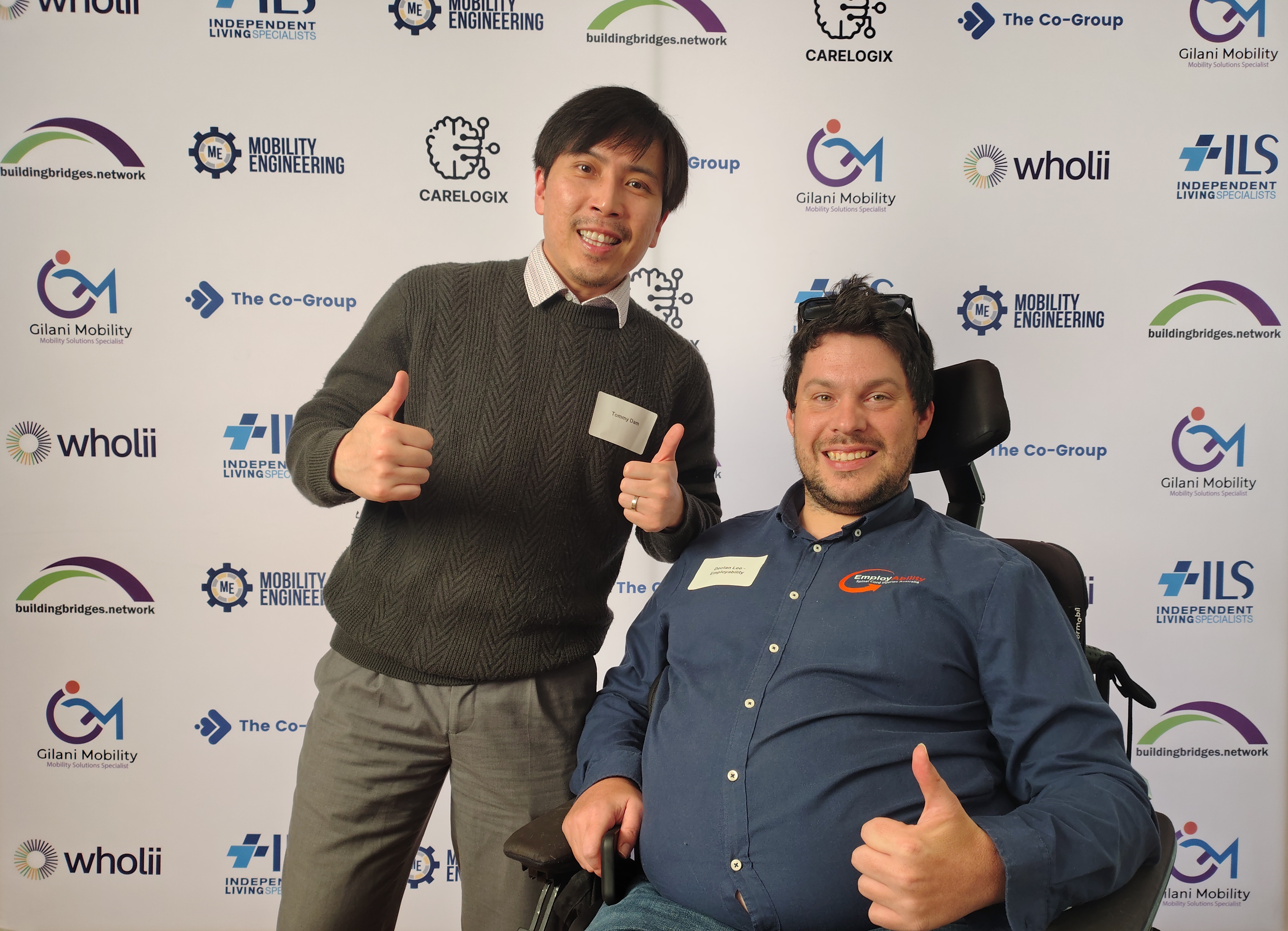
One of the more energising conversations of the day came from Declan Lee, Disability Employment Ambassador for EmployAbility. Declan's presence at Building Bridges was a reminder that employment is not a peripheral issue for the disability sector — it is central to dignity, independence, and quality of life.
EmployAbility is dedicated to supporting Australians with disability to find and maintain meaningful employment. As an ambassador, Declan brings both personal insight and practical knowledge to the conversation, helping to bridge the gap between employers who want to do better and job seekers who deserve a genuine opportunity.
With the right support, people with disability are valuable ones as inclusive workplaces benefit everyone, and organisations like EmployAbility are doing the on-the-ground work to make that a reality across Australia.
If you are an employer looking to build a more inclusive workforce, or someone with disability exploring your employment options, EmployAbility is a resource worth knowing about.
Sydney Water provides financial relief for residents facing hardship

One of the more surprising — and immediately useful — pieces of information to emerge from the event came from Sydney Water. Many attendees were unaware that Sydney Water operates a support program specifically designed for residents facing financial difficulties. Through this program, eligible households can access reduced water prices, easing the financial burden on individuals and families who are already stretched thin.
For support workers and coordinators who regularly work alongside participants experiencing financial hardship, this is exactly the kind of practical information that can make a real difference. Knowing that utility costs can be reduced through a formal support pathway gives frontline workers another tool in their kit when helping clients navigate financial stress.
The presence of Sydney Water at a disability and community services event is itself a reminder that the wellbeing of vulnerable Australians is not the sole responsibility of the care sector. Utility providers, housing agencies, and other public services all have a role to play — and Building Bridges is one of the few spaces where those worlds come together.
Ageing and Disability Commission supporting the protection of vulnerable Australians
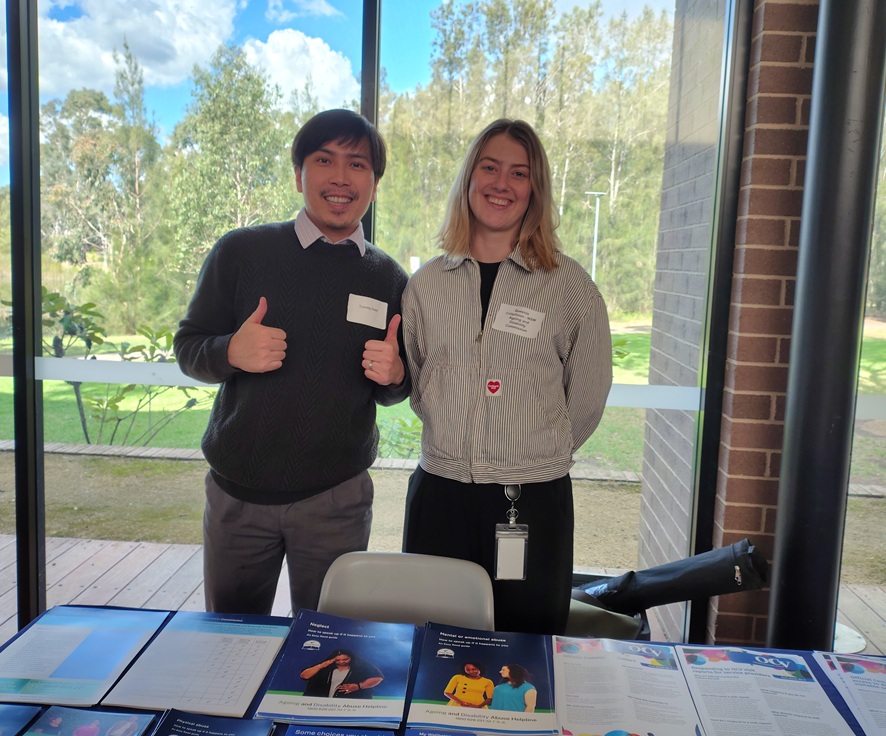
Queenie Colqohoun made a meaningful appearance at the event, represented The Ageing and Disability Commission (ADC), bringing resources focused on one of the sector's most critical concerns: the protection of vulnerable Australians from exploitation, abuse, and neglect.
The ADC's work is foundational to the integrity of the disability and ageing care sectors. It provides independent oversight, handles complaints, and promotes awareness of the rights of people with disability and older people. At Building Bridges, the Commission shared resources designed to help practitioners, families, and community members recognise and respond to signs of abuse and neglect.
The resources covered how to identify warning signs of exploitation — financial, emotional, physical, and social. They also outlined the reporting pathways available when concerns arise, and emphasised the importance of a community-wide approach to safeguarding. No single organisation can protect vulnerable people alone; it requires vigilance across every touchpoint in a person's life.
For attendees working in direct support roles, this was a timely and sobering reminder of the responsibilities that come with access to people's homes, finances, and daily lives. The ADC's presence reinforced that safeguarding is not an afterthought — it is core business.
Palliative Care NSW help provider navigating the End of Life Journey with Dignity
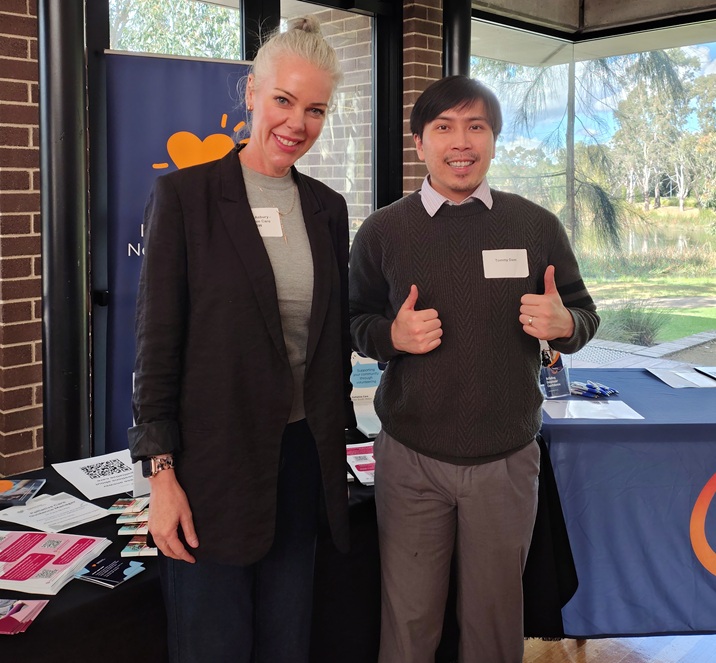
Megan Asbury from Palliative Care NSW, the peak body for palliative care in the state, brought an important and often underrepresented perspective to the table: the end of life stage of the care journey.
For disability service providers, the topic of end of life care can be unfamiliar territory. Many organisations are focused on building capacity, maximising independence, and supporting long-term goals — which is exactly as it should be. But as participants age, or as conditions progress, the care journey inevitably leads to a point where palliative considerations become relevant. Knowing how to navigate this with sensitivity, dignity, and appropriate coordination of services is essential.
Palliative Care NSW provided guidance on what palliative care actually means in practice — and what it does not mean. It is not simply about the final days of life. Palliative care is an approach that improves the quality of life of individuals and their families facing life-threatening illness, through the prevention and relief of suffering. It can and should begin well before the end of life, and it involves coordination across medical, emotional, social, and spiritual dimensions of care.
For support workers and coordinators, the key takeaway was simple but profound: when a participant's condition changes, the conversation about their goals and wishes needs to change too. Palliative Care NSW offers guidance, training, and resources to help organisations and individuals have those conversations well.
The NSW Trustee and Guardian provides planning, protection and peace of mind
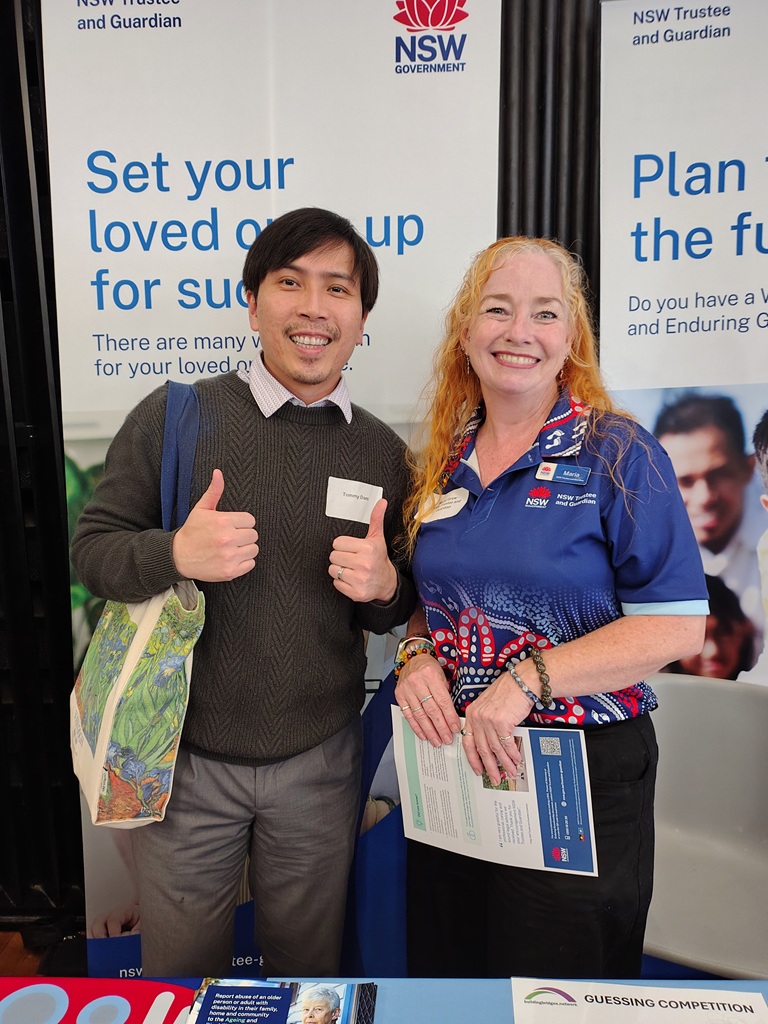
Perhaps no organisation on the day carried more urgency for both workers and participants than NSW Trustee and Guardian. Maria’s table was busy throughout the event, and for good reason. Maria gave briefly cover of Wills, Power of Attorney, Enduring Guardianship Appointment, and Advance Care Planning, a touch on fundamental questions of autonomy, dignity, and protection that affect everyone.
Wills — Many Australians, including many people with disability, do not have a Will in place. NSW Trustee and Guardian provides accessible Will-making services and can act as executor when needed. Having a Will ensures that a person's wishes are respected after death and that their estate is managed according to their intentions — not by default rules that may not reflect their values or relationships.
Power of Attorney — A Power of Attorney authorises another person to make financial and legal decisions on your behalf. For participants who may lose capacity due to illness or injury, having a POA in place in advance is a critical safeguard. NSW Trustee and Guardian can act as attorney when there is no suitable family member or friend available, providing an independent and trustworthy option.
Enduring Guardianship Appointment — An Enduring Guardianship Appointment authorises a trusted person to make lifestyle, health, and medical decisions on your behalf if you lose the capacity to make those decisions yourself. This includes decisions about where you live, what medical treatment you receive, and what services you access. For people with disability, having this appointment in place is an act of profound self-determination.
Advance Care Planning — Advance Care Planning is the process of thinking about, talking about, and recording your preferences for future health care. It ensures that if you are ever unable to speak for yourself, the people caring for you know what matters most to you. It is relevant for anyone who values having their wishes respected, regardless of age or health status.
The presence of NSW Trustee and Guardian at Building Bridges was a powerful reminder that legal and financial planning is part of holistic care. For support coordinators and social workers, being able to point people toward trusted, accessible services in this space is part of doing the job well.
Here's the excerpt, ready to copy and paste into your blog:
Justice Advocacy Service (JAS) Providing Free Legal Support for People with Cognitive Impairment

Navigating the criminal justice system is daunting for anyone. For someone with a cognitive impairment, it can be overwhelming, confusing, and deeply isolating. The Justice Advocacy Service (JAS), a service of the Intellectual Disability Rights Service (IDRS), exists to change that and I met Sam Valentine at the event.
JAS provides a trained support person to stand alongside people with cognitive impairment at every stage of their journey through the criminal justice system. Importantly, no evidence of disability is required to access the service — if there is a reason to believe someone may have a cognitive impairment, that is enough to make a referral. The service is completely free.
JAS offers 24/7 support across a wide range of situations, including:
Reporting a crime to police
Being interviewed by police
Being under arrest at a police station
Applying for a domestic, family, or personal violence order
Appearing at court
Meeting with a criminal lawyer
The support JAS provides is practical, immediate, and person-centred. Their advocates help ensure that people with cognitive impairment are not lost in a system that was not designed with them in mind — that their rights are upheld, their voices are heard, and they are not navigating one of the most stressful experiences of their lives alone.
If you are working with someone who is going through the criminal justice system and you suspect they may have a cognitive impairment, do not wait for a formal diagnosis. Refer them to JAS. Early support can make all the difference.
Innovation Spotlight The Carelogix Platform
Carelogix platform is a compelling example of how technology is changing the landscape of care delivery. Designed specifically for healthcare and disability service organisations, Carelogix addresses one of the sector's most persistent pain points: the gap between what happens at the point of care and what gets recorded, reported, and acted upon.
The platform comprises two integrated tools: Carelogix Nexus, a sophisticated web application, and Carelogix Note, a purpose-built mobile application. Together, they create a seamless ecosystem that empowers frontline workers to capture richer, more accurate data — and empowers organisations to turn that data into better outcomes for participants.
The platform's vision is enabling people to live longer in the comfort of their own homes. This is not just an aspirational statement. It shapes every technological decision within the platform, and it reflects a profound truth about human dignity: that home represents independence, familiarity, and the irreplaceable comfort of one's own environment.
Carelogix Nexus serves as the central intelligence hub. It processes and presents critical information with a strong emphasis on security, scalability, and usability. Built on Microsoft Azure infrastructure with all data stored within the Australia East region, it meets Australian data sovereignty requirements. Multi-Factor Authentication is mandatory for all users, and all data is encrypted in transit and at rest. The platform also features an AI-powered chatbot that allows staff to upload documents — care plans, policies, clinical guidelines — and query them using natural language, with every output traceable to its source.
Carelogix Note is the mobile face of the platform — an intuitive data collection tool designed for the realities of frontline care work. It supports a Bring Your Own Device model, allowing workers to use familiar devices in clients' homes. Single-touch voice recording lets workers document observations hands-free. Voice-activated AI gives instant access to participant-specific documents stored in Nexus. Location tracking records arrival and departure times automatically. Photo capture supports visual documentation of medication administration, wound care, and more.
At the end of each service, Carelogix Note automatically generates a comprehensive report from all collected data — eliminating hours of manual report-writing and improving both the quality and consistency of documentation across the organisation.
For the sector, the implications are significant. Real-time data enables proactive care management. Detailed, traceable records support compliance with NDIS quality standards. Leadership gains direct visibility into frontline operations. Behaviour support clinicians can review service delivery data to assess the effectiveness of their interventions. And restrictive practices documentation — one of the most demanding compliance areas in the sector — can be captured at the point of care with the granularity that regulators require and that participants deserve.
Carelogix is a reminder that technology, when designed with genuine care for the human beings at the centre of the system, does not depersonalise care — it deepens it and is a vital component for facilitating existing escalation pathway to external systems such as aforementioned services by government, peak bodies and private specialised care.
There were many other organisation’s such as the NSW Police, Services NSW, Carer’s Gateway, the CO-GROUP and many more. Hopefully next time I could get more information to put on this blog.
Closing Reflections

The April 30 edition of Building Bridges left attendees with something more valuable than a stack of brochures and a pocketful of business cards. It left them with a renewed sense of what is possible when the right people are in the same room.
The resources shared on the day — from EmployAbility’s inclusive workplace to Sydney Water's financial support program, and the ADC's safeguarding tools, from Palliative Care NSW's end-of-life guidance to NSW Trustee and Guardian's planning services — represent the kind of holistic, connected approach that the community services sector needs more of.
None of these organisations can achieve their mission in isolation. Neither can the people who attend Building Bridges. But together, in a room at the Woodcroft Community Neighbourhood Centre on a Wednesday afternoon in autumn, something genuinely useful was built. Connections were made. Knowledge was shared. The sector moved, however incrementally, in the right direction.
That is what Building Bridges is for. And that is why it matters.
Related Articles

NDIS Building Bridges Network Mar 2026
Building Bridges Network — March 2026 Recap: Trauma Informed Care The March 2026 edition of the Building Bridges Network brought together disability...

NDIS Building Bridges Network Feb 2026
Building Bridges has always positioned itself as a platform to connect, educate, and empower those working in and around the disability sector.

NDIS Building Bridges Network Jan 2025
The I-CAN tool has been trialled and endorsed by the Centre for Ability for approximately two years, but it has never been piloted under the NDIS itself — a fact that understandably has the sector on edge.